

The Rule 4 Machine
How Lorain Turned A Political Rant Into A Criminal Warrant

By Aaron Christopher Knapp
Editor-in-Chief, Knapp Unplugged Media LLC
Lorain Politics Unplugged
There is a sentence buried near the end of Lt. Kyle Gelenius’s March 18, 2026 supplemental investigative report that explains the whole machine.

After pages of selectively framed speech, emotional witness reactions, psychological commentary, attacks on my journalism, attacks on my social-work identity, references to my lawsuits, references to my public-records activity, and conclusions about my supposed motives, Gelenius wrote that he was requesting the investigation be forwarded to the Lorain Municipal Prosecutor for review and, if appropriate, presentation at a Rule 4 hearing. That sentence matters because it shows what this document was designed to become. It was not merely a police report, a neutral summary, or a routine file note. It was a charging package. It was a probable-cause narrative. It was the document built to move speech from Facebook to the prosecutor, from the prosecutor to a judicial officer, and from a judicial officer to an arrest warrant.
And that is exactly what happened, the Lorain Police case summary for Case No. 2026-00004965 lists the incident type as Telecommunication Harassment, identifies me as the suspect, lists three telecommunications-harassment counts under R.C. 2917.21, lists one possessing-criminal-tools count under R.C. 2923.24, and states that the disposition was “Warrant Issued” on March 20, 2026. Two days after Gelenius dated the report, the warrant existed.
That timing matters because this was not a spontaneous street-level decision made in the middle of an unfolding emergency. The record shows a prepared investigative packet, a preserved screen recording, an AI-assisted transcript, witness statements, witness interviews, statutory analysis, character framing, and a formal request for prosecutor review and possible Rule 4 presentation. The same packet later became part of a larger public release package that included redacted reports and video links provided to media outlets after my arrest.
The government had time to collect, frame, redact, package, and distribute its version of the story. My attorney did not receive meaningful access to the underlying evidence for days after the arrest, while the public-facing version of the case was already moving through police records channels and media channels.
That is why this first article is not about whether every word I said in a late-night Facebook Live was polite, restrained, elegant, or politically convenient. It was not. The record contains ugly language. The government quoted it at length. Anyone pretending otherwise is not reading the same packet. But ugly language is not the legal standard. Profanity is not probable cause by itself. Political anger is not automatically telecommunications harassment. Public criticism of officials, reporters, prosecutors, police officers, and government actors does not become criminal merely because the people criticized say they were upset, embarrassed, alarmed, or offended.
The legal question is not whether Aaron Knapp cursed. The legal question is whether Lorain officials used profanity, political rage, public-records conflict, lawsuits, threatened litigation, and criticism of public officials as the raw material for a criminal case. The legal question is whether the Rule 4 process was used as a neutral probable-cause filter or as a laundering device for a government narrative that had already decided who I was before it ever analyzed what the law actually required.
Under Ohio Criminal Rule 4, a warrant or summons may issue only if it appears from the complaint, or from an affidavit or affidavits filed with the complaint, that there is probable cause to believe an offense was committed and that the defendant committed it. The rule allows probable cause to be based on hearsay, but only where there is a substantial basis for believing the hearsay source is credible and a factual basis for the information supplied. The rule also permits the issuing authority, before ruling on a warrant request, to require the complainant and witnesses to appear personally and be examined under oath. If that testimony was taken down by a court reporter or recording equipment, it may later be admissible at a suppression hearing.
That distinction matters. Rule 4 does not mean a judge must always hold a full public evidentiary hearing before a warrant issues. But if Lorain claims there was a Rule 4 hearing, sworn testimony, oral presentation, witness examination, or live probable-cause presentation, then the obvious questions are unavoidable. Who appeared? Who testified? Was anyone placed under oath? Was the testimony recorded? Was a court reporter present? Was any audio or video made? Did the issuing authority review the actual recording, the AI-assisted transcript, the police summary, the complaint, the affidavits, or selected excerpts chosen by the investigator?
If there was no testimony and no recording, then the warrant must stand or fall on the written complaint, affidavits, and materials actually filed with the complaint. That is why the complete Rule 4 record matters. The public has seen the police narrative. The defense needs the judicial record. There is a difference between a police officer writing a persuasive report and a neutral issuing authority making an independent probable-cause determination based on sworn facts.
The record also raises a second question that should not be ignored. Criminal Rule 4 expressly says the issuing authority shall issue a summons instead of a warrant upon the request of the prosecuting attorney, or when issuance of a summons appears reasonably calculated to ensure the defendant’s appearance. I was not an unknown suspect. I was not hiding. I had a known address. I was publicly identifiable. I had active litigation. I had counsel. The alleged evidence was not disappearing in real time because the police already had a screen recording, a transcript, witness statements, and a completed investigative packet. So why was the process designed to produce an arrest warrant instead of a summons?
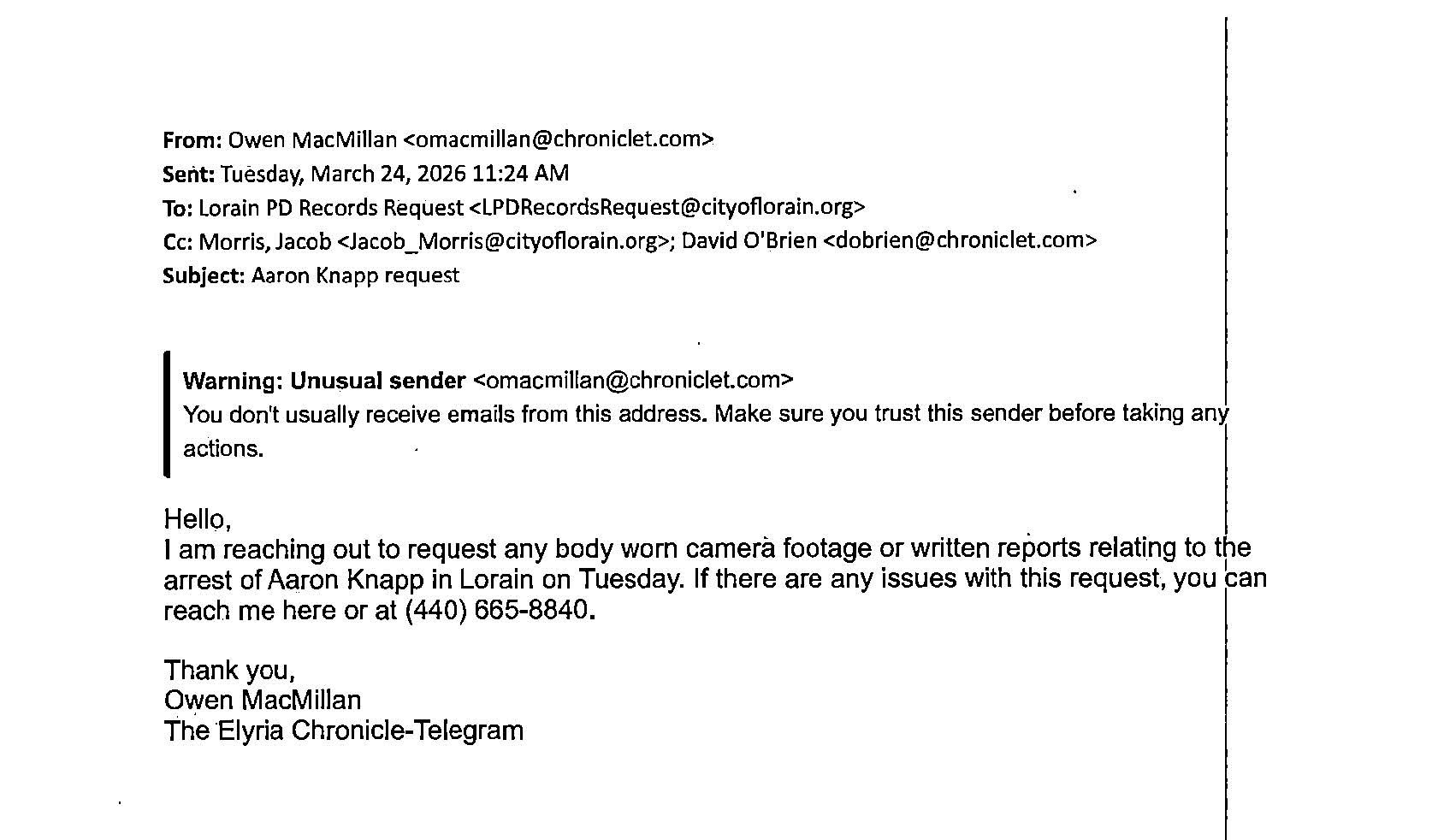
That question becomes even more serious when viewed against what happened next. Captain Jacob Morris later confirmed that the Chronicle-Telegram, Lorain Daily, and The Morning Journal were the three media sources he knew had requested information, and that Lorain Police provided “all of the redacted information” to them, with the Chronicle and Lorain Daily receiving digital fulfillment by email and cloud link. The March 24 release email stated that the attached materials were “all publicly available reports pertaining to the arrest of Aaron Knapp today,” and it included a link to redacted body-camera video from the arresting officer and the back-seat cruiser camera video of my transport to the Lorain County Jail.
So the government had evidence ready for a warrant. It had reports ready for redaction. It had video links ready for release. It had a media package ready for distribution. But I did not receive meaningful access to the underlying evidence for days after the arrest.
That is the part the public needs to understand. This was not just a criminal case. It was a prepackaged narrative event. The arrest, the reports, the video links, the media disclosures, and the delayed defense access all sit inside the same timeline.
The first question is whether the Rule 4 process was real, complete, recorded where required, and supported by the materials actually presented to the issuing authority. The second question is why a summons was not used when Criminal Rule 4 expressly makes summons an alternative where appearance can reasonably be secured. The third question is why the government was able to package and release its narrative to the press before I had the evidence needed to answer it in court. That is the machine. The Facebook Live was only the beginning. The real story is what Lorain built from it.
What Rule 4 Is Supposed To Do
Ohio Criminal Rule 4 is the gatekeeping rule for warrants and summonses on criminal complaints. It is the rule that stands between an accusation and the government’s power to arrest. It says that a warrant or summons may issue only if it appears from the complaint, or from an affidavit or affidavits filed with the complaint, that there is probable cause to believe an offense has been committed and that the defendant committed it. It also permits probable cause to be based on hearsay, but only if there is a substantial basis for believing the source of the hearsay is credible and a factual basis for the information supplied. Before ruling on a request for a warrant, the issuing authority may require the complainant to appear personally and may examine the complainant and witnesses under oath. If that testimony is taken down by a court reporter or recording equipment, it may later be admissible at a hearing on a motion to suppress.
That means Rule 4 is not supposed to be a rubber stamp. It is supposed to be the place where criminal allegations are tested enough to decide whether the government may take the next step. It is supposed to require facts, not merely outrage. It is supposed to require probable cause, not merely disgust. It is supposed to require an element-by-element connection between alleged conduct and criminal law, not an officer’s broad conclusion that a defendant is abrasive, angry, disliked, unethical, unstable, politically inconvenient, or too loud for City Hall. That distinction is everything in my case.
The police report does not simply say: here are the exact statements, here are the exact recipients, here is the exact statutory subsection, here is the factual basis for concluding those statements were made with the purpose to abuse, threaten, or harass, and here is why an arrest warrant was necessary instead of a summons. That last point matters because Criminal Rule 4 expressly says the issuing authority shall issue a summons instead of a warrant upon the request of the prosecuting attorney, or when issuance of a summons appears reasonably calculated to ensure the defendant’s appearance.
I was not an unknown suspect. I was not hiding. I had a known address. I was publicly identifiable. I had active litigation. I had counsel. The alleged evidence was not vanishing in real time because the police already had a screen-recorded video, an AI-assisted transcript, witness emails, witness interviews, and a completed investigative report.
The case summary says the disposition became “Warrant Issued” on March 20, 2026, two days after Lt. Gelenius dated the supplemental investigative report. Instead of a narrow probable-cause presentation, the report takes the reader on a tour through my character. It discusses my lawsuits. It discusses my public-records requests. It discusses my unemployment. It discusses my reputation. It discusses my social-work identity. It discusses my journalism. It suggests I have an “inflated self-image.” It describes my speech as “emotionally dysregulated.” It frames my public-records activity as an attempt to “overload” and “shut down” government. It criticizes my claimed role as an investigative journalist and states that my conduct conflicts with journalism standards. It then moves into social-work ethics and suggests that my behavior conflicts with those principles as well. Those themes appear in a report that was not merely documenting a complaint, but expressly asking that the investigation be sent to the Lorain Municipal Prosecutor for review and, if appropriate, presentation at a Rule 4 hearing.
That is not neutral probable-cause writing. That is character assassination wearing a badge.
The question now is what actually happened at the Rule 4 stage. Was there a sworn complaint? Was there an affidavit filed with the complaint? Was the entire investigative report given to the issuing authority? Was the AI-assisted transcript provided? Was the original video reviewed, or only selected excerpts? Did any complainant or witness appear personally? Was anyone examined under oath? Was a court reporter present? Was there recording equipment? Did the prosecutor ask for a warrant instead of a summons? Did the issuing authority make an independent finding explaining why arrest was necessary when summons was available under the rule?
Those questions matter because Criminal Rule 4 does not exist to bless a prewritten police narrative. It exists to require a neutral probable-cause determination before the government uses criminal process against a person. If no testimony was taken and no recording exists, then the warrant must stand or fall on the complaint, affidavits, and written materials actually filed. If testimony was taken, then the defense and the public deserve to know whether it was recorded, who testified, what was said, and whether the testimony can be tested in a suppression hearing under the rule.
That is the difference between process and theater. The government had days to package its version of events. It had the video. It had the transcript. It had the witness statements. It had the reports. It had the redactions. It later had the media-release packet ready for distribution. But I did not receive meaningful access to the underlying evidence for days after the arrest, while the government’s version was already moving through police, court, and media channels. That is why Rule 4 matters here. It is the point where a court was supposed to test whether this was really probable cause, or whether Lorain had simply converted political speech, profanity, records disputes, and personal hostility into a prepackaged arrest.
The Statute They Used
The central charge is telecommunications harassment under R.C. 2917.21. The statute prohibits, among other things, making or causing a telecommunication with purpose to abuse, threaten, or harass another person. It also prohibits knowingly posting a text, audio statement, image, or other covered material on an internet website or webpage for the purpose of abusing, threatening, or harassing another person. In this case, the Lorain Police case summary for Case No. 2026-00004965 lists three telecommunications-harassment counts under R.C. 2917.21 and one possessing-criminal-tools count under R.C. 2923.24. The same case summary states that the disposition was “Warrant Issued” on March 20, 2026.
That word purpose is not decoration. It is the whole case.
The State has to prove more than offense. It has to prove more than anger, embarrassment, public criticism, reputational discomfort, political pressure, profanity, vulgarity, or emotional reaction by the person being criticized. It has to prove more than a public official saying she felt afraid. It has to prove more than a police officer writing that a post had “no legitimate purpose.”
The legal burden is not satisfied by showing that the speech was harsh. The legal burden is not satisfied by showing that the listener was upset. The legal burden is not satisfied by showing that the words were indecent, crude, insulting, or personally humiliating.
The State must prove that the communication or post was made for the prohibited purpose required by the statute. That is where the Lorain report stretches the law.
The report repeatedly treats the impact of the speech as proof of the purpose behind the speech. It emphasizes that people were upset. It emphasizes that people felt alarmed. It emphasizes that people felt harassed, abused, frightened, embarrassed, angry, or emotionally harmed. It emphasizes that one complainant said the video caused a panic attack. It emphasizes that another witness characterized the video in extreme emotional terms. It emphasizes that the language was vulgar, offensive, and misogynistic. It then takes those reactions and uses them to build the conclusion that the speech must have been criminal.
But emotional impact is not the same thing as criminal purpose.
That distinction matters because political speech often causes emotional impact. Public-records litigation causes emotional impact. Accusations of misconduct cause emotional impact. Lawsuits cause emotional impact. News coverage causes emotional impact. Public criticism of elected officials, police officers, prosecutors, reporters, and government employees can embarrass people, anger people, frighten people, and damage reputations. That does not automatically make the speaker a criminal.
The government can use impact as evidence. But it cannot skip the rest of the analysis. When speech involves public officials, public records, lawsuits, media coverage, election activity, government misconduct allegations, police conduct, and the conduct of people involved in public controversy, the government must separate criminal harassment from protected political speech. That separation is not optional. It is the constitutional fault line in the entire case.
The report does the opposite. Instead of carefully separating protected speech from allegedly criminal speech, it blends everything together. It treats public-records requests, threatened litigation, lawsuits, criticism of officials, criticism of reporters, criticism of prosecutors, criticism of police, and the emotional reaction of the people criticized as one continuous proof package. It then says the speech served “no legitimate purpose,” even though the report’s own excerpts show that the video discussed government officials, records disputes, alleged misconduct, election conduct, media coverage, and public controversy. That is the danger.
If the State can define “no legitimate purpose” by ignoring the public issues being discussed and focusing only on the vulgarity of the language, then the statute becomes a weapon against political rage instead of a tool against true harassment. If the government can treat the listener’s emotional reaction as a substitute for the speaker’s criminal purpose, then any aggressive critic of public officials can be criminalized the moment the official says the criticism caused fear, panic, humiliation, or distress.
That is not how the First Amendment is supposed to work. That is not how Rule 4 is supposed to work. And that is not how probable cause should be built in a case where the alleged crime is speech.
The Speech Was Ugly. It Was Also Political.
The police report quotes heavily from my January 11, 2026 Facebook Live. It describes the video as approximately twenty-six minutes and fifty-three seconds long. It states that the video was screen-recorded and later provided to the Lorain Police Department by Safety-Service Director Tim Williams on or about February 10, 2026. It further states that the transcript included in the police report was prepared with the assistance of artificial intelligence and that the original recording was retained as evidence.
That AI-transcript admission alone should stop everyone cold.
If an AI-assisted transcript was used as part of the investigative foundation, then the defense has a right to know exactly what was used, who generated it, what software or service was used, whether the transcript was edited, whether draft versions exist, whether timestamps exist, whether the issuing authority watched the video or merely read selected excerpts, whether the transcript captured tone and context accurately, and whether the State relied on selected portions rather than the entire recording. In a speech case, words matter. Tone matters. Sequence matters. Context matters. Omissions matter. A transcript created with artificial-intelligence assistance may be a useful working aid, but it is not a substitute for the actual recording, and it should never become the untested foundation for a criminal warrant without disclosure, verification, and adversarial review.
That is especially true here because the same report was not simply preserving evidence. It was building a criminal theory. It took a late-night political broadcast, converted it into a police transcript, surrounded it with witness reactions, added officer analysis, included commentary about my journalism and social work, and then asked that the matter be forwarded to the Lorain Municipal Prosecutor for possible Rule 4 presentation. The report was dated March 18, 2026, and the Lorain Police case summary later listed the disposition as “Warrant Issued” on March 20, 2026.
But even from the report’s own selected excerpts, the speech was not disconnected private abuse floating in empty space. It was a vulgar public rant about public officials, prosecutors, sheriffs, reporters, council members, public records, lawsuits, alleged election interference, alleged email sharing, alleged misconduct, and the way government actors had treated me. It named public figures and media actors. It referenced government offices. It referenced litigation. It referenced accusations of misconduct. It referenced public controversy. It was ugly, angry, profane, and personally offensive, but it was still bound up with political conflict and public accountability disputes.
That does not make every word noble. It does not make every sentence defensible as a matter of judgment. It does not mean anyone named in the video was required to like it, excuse it, forgive it, or remain silent about it. It does make the First Amendment issue unavoidable.
The police report wants to reduce the speech to personal abuse. The broader context shows something more complicated. It was a public-facing political broadcast by a government critic who had spent years filing public-records requests, lawsuits, complaints, articles, and public accusations against the same public ecosystem now helping turn that speech into criminal charges. The report’s theory depends on stripping away that context and leaving only the profanity, the emotional reactions, and the officer’s conclusion that the speech had no legitimate purpose.
That is not how speech analysis works. A court does not have to like the speech. The public does not have to like the speech. The officials, reporters, prosecutors, and police officers named in it do not have to like the speech. But criminal law requires more than dislike, more than disgust, more than embarrassment, and more than emotional impact. It requires proof that the speech crossed the legal line into criminal conduct.
That is why the AI-assisted transcript matters. That is why the full recording matters. That is why the complete Rule 4 record matters. If the government wants to prosecute a person for speech, then the government should be required to show the whole speech, the whole context, the whole basis for probable cause, and the exact record presented to the issuing authority. Anything less turns a political rant into a police-curated exhibit, and then turns that exhibit into an arrest warrant before the defense even has a fair chance to test what was actually said, how it was said, and why it was said.
The Report Conflates Speaking About Someone With Speaking To Someone
One of the most important pieces of the report is the way it handles the word “you.”
The report claims that my use of “you” suggests I was speaking to the alleged victims rather than about them. It then argues that, in the least favorable light, I knew the communication would reach them, and in the most favorable light, I expected a high likelihood that the post would reach them because the page was public and had nearly 1,000 followers. That is the State’s bridge. Without that bridge, the case has a problem. A public Facebook Live is not the same thing as a direct phone call, direct text message, direct email, voicemail, or private message. A person can speak about public officials in a public forum without directly communicating with those officials. A person can rant about a reporter without sending that reporter the rant. A person can criticize a council member without directly placing a call to that council member’s home.
The State appears to know that. That is why the report tries to transform public speech into directed speech by emphasizing second-person language, the public nature of the page, the follower count, and the possibility that the people discussed would eventually see or hear about the video. But that is not a small move. That is the entire legal transformation. The report takes a public-facing political broadcast and tries to treat it like a targeted communication because some of the statements used the word “you” and because people who were discussed eventually became aware of it.
That theory becomes even more troubling because the police report admits they did not have the original Facebook Live in its original platform environment. The report states that the video was screen-recorded and provided to the Lorain Police Department by Safety-Service Director Tim Williams on or about February 10, 2026. It also states that, at the time of the report, the original video had either been deleted or had its visibility settings changed to restrict who could view it, according to information obtained from Facebook postings. The report then says the transcript was prepared with the assistance of artificial intelligence after reviewing the video recording.
That matters because the government was not working from the native Facebook Live record. It was working from a screen recording supplied by a City official who was also part of the same political and governmental ecosystem being criticized. If the government wanted to claim that the original post was public, directed, intended to reach specific people, viewed by specific people, shared in a particular way, deleted for a particular reason, or hidden for a particular reason, then the original platform data matters. The metadata matters. The original privacy settings matter. The audience data matters. The timing matters. The deletion or visibility-change claim matters. A screen recording may preserve content, but it does not automatically prove distribution, intent, audience, reach, delivery, or purpose.
That is why using the alleged deletion or visibility change as part of the justification to seize my phone is so dangerous. The police already had a screen recording. They already had the words they claimed mattered. They already had an AI-assisted transcript. They already had witness reactions. They already had the report. If the theory was that the Facebook Live itself was the offense, then the State must explain what evidence existed only on my phone that could not be obtained from Facebook, from the person who screen-recorded the video, from the witnesses who viewed it, from the public page records, or from ordinary preservation requests. A claimed deletion or changed visibility setting should not become a shortcut around the constitutional limits on searching a journalist’s phone.
The government cannot have it both ways. It cannot say the video was public enough to prove I intended the alleged victims to receive it, but unavailable enough to justify seizing my private phone. It cannot say the screen recording was reliable enough to support a Rule 4 warrant, but incomplete enough to justify entering the rest of my digital life. It cannot say the AI-assisted transcript captured the criminal speech, but then claim the original device was needed because the evidence was supposedly missing. Those contradictions are exactly why the defense needs the complete Rule 4 record, the original search-warrant materials, the screen recording, the AI transcript history, the Facebook preservation efforts, and every communication explaining why the phone was targeted.
If the State’s theory is accepted too casually, it creates a dangerous rule. Every public post about a public official could become a communication “to” that official if the speaker uses second-person language and the official later sees it. Every political rant could become harassment if someone forwards it to the subject. Every activist page could become a criminal telecommunications device if the government says the public nature of the post made it likely the subject would hear about it. Every deleted or restricted post could become a reason to seize a phone, even where the government already has a screen recording and already quoted the words it claims are criminal.
That cannot be the law without swallowing a huge amount of protected speech. The State must do more than say the speech was public and the targets found out. It must do more than point to the word “you.” It must do more than rely on a screen recording provided by a government official and an AI-assisted transcript prepared after the fact. It must prove criminal purpose. It must prove that the post was made for the purpose prohibited by R.C. 2917.21, not merely that the speech was ugly, public, political, forwarded, discussed, or emotionally upsetting. That is the real bridge the State has not crossed.
The Lawsuit Threat Theory Is One Of The Most Dangerous Parts
One of the most dangerous parts of the report is the way it treats threatened litigation as evidence of harassment. The report does not merely say that I used ugly language. It goes further. It folds my repeated threats to sue public officials into the emotional-distress theory of the case. It says that repeated threats of litigation can create anxiety, worry about financial loss, reputational harm, uncertainty, racing thoughts, difficulty concentrating, pressure, helplessness, and fear. The report then uses that alleged emotional impact as part of the broader argument that my speech was abusive, threatening, or harassing under R.C. 2917.21.
That section is astonishing.
Public officials get sued. Police departments get sued. Cities get sued. Prosecutors get criticized. Public-records requesters threaten mandamus actions. Civil-rights plaintiffs warn governments about litigation. Journalists tell public offices they may be sued if they violate constitutional rights, public-records laws, open-meetings laws, or anti-retaliation protections. Citizens complain, threaten legal action, demand preservation of evidence, request insurance information, accuse officials of misconduct, and tell government actors that court may be next.
That is not automatically harassment. The right to petition government and seek redress does not disappear because a public official feels stressed by the possibility of litigation. A lawsuit threat can become legally problematic if it is knowingly baseless, extortionate, fraudulent, tied to an unlawful demand, or used as part of conduct that independently crosses a criminal line. But the report does not do that careful work. It does not identify a specific litigation threat and explain why that threat was unlawful. It does not distinguish between protected petitioning activity and criminal coercion. It does not separate ordinary civil-rights threats, public-records enforcement threats, defamation warnings, mandamus warnings, preservation demands, and political accountability claims from actual criminal harassment. It simply folds litigation pressure into emotional distress, then uses emotional distress to support the harassment theory.
That should concern anyone who has ever filed a public-records request, threatened a lawsuit, challenged a city ordinance, complained about police, criticized a prosecutor, demanded a public-records response, warned a public office to preserve evidence, or told an elected official that court may be next.
The danger is not subtle. If threatened litigation becomes part of a criminal-harassment theory merely because officials find it stressful, then accountability itself becomes suspicious. A citizen who says, “I am going to sue you,” becomes easier to frame as abusive. A records requester who says, “I will file mandamus,” becomes easier to frame as coercive. A civil-rights plaintiff who says, “You are violating my rights and I will take this to court,” becomes easier to frame as emotionally harmful. That would turn the normal language of government accountability into evidence of criminal intent.
That is exactly why the Rule 4 record matters. If a warrant issued based in part on a report that treated threatened lawsuits as evidence of harassment, then the issuing authority needed to separate protected legal redress from criminal purpose. The court needed to ask whether the alleged threats were unlawful threats or protected warnings of litigation. It needed to ask whether the report was proving a crime or simply criminalizing the discomfort public officials feel when citizens use courts, records laws, and public criticism to challenge power.
Because if the government can turn “I am going to sue you” into part of a criminal probable-cause package without showing that the litigation threat was unlawful, then the message to every citizen is clear. You may have the right to petition government on paper, but exercise it too aggressively against the wrong officials, and they may call it harassment.
The Criminal Tools Charge Is Even More Troubling
The criminal-tools charge is even more troubling because it appears to be the bridge between a speech prosecution, the seizure of my phone, and a much broader search theory that reached beyond the Facebook Live itself.
The packet lists one count of possessing criminal tools under R.C. 2923.24. That statute prohibits possessing or controlling a substance, device, instrument, or article with purpose to use it criminally. It also identifies circumstances that may create prima facie evidence of criminal purpose, such as possession of dangerous ordnance, possession of an item specially adapted for criminal use, or possession of an item commonly used for criminal purposes under circumstances indicating intended criminal use. In this case, the alleged “tool” appears to be my phone, or possibly “phones” more broadly, because the underlying theory was that my January 11, 2026 Facebook Live constituted telecommunications harassment. The Lorain Police case summary for Case No. 2026-00004965 lists three counts of telecommunications harassment under R.C. 2917.21 and one count of possessing criminal tools under R.C. 2923.24. The same packet identifies the evidence as a screen recording of my Facebook Live and an email from one of the alleged victims. It also states that the Facebook Live was screen-recorded and provided to Lorain Police by Safety-Service Director Tim Williams on or about February 10, 2026, and that the transcript used in the report was prepared with the assistance of artificial intelligence.
That is the stated logic. The government treated the Facebook Live as the alleged criminal communication. It then treated the phone as the device supposedly used to create, transmit, post, delete, restrict, manage, preserve, or conceal that communication. From there, the phone became evidence, and the “criminal tools” charge became the legal doorway to digital seizure. But according to the testimony, Lt. Gelenius also stated that they were using my phone to conduct multiple investigations. That changes the issue completely. If the phone was seized under a warrant supposedly tied to one Facebook Live and one telecommunications-harassment theory, but then became a device used to pursue multiple investigations, the warrant stops looking like a narrow evidence-preservation tool and starts looking like a digital dragnet.
That is an extraordinary theory when the charged conduct is speech.
A phone is not contraband. A phone is not a weapon. A phone is not specially adapted for crime. A phone is how modern citizens speak, record, report, document, photograph, text, email, file public-records requests, communicate with attorneys, maintain family contact, use two-factor authentication, preserve evidence, manage medical information, and publish journalism. For me, it is also part of my reporting infrastructure, my litigation infrastructure, my public-records infrastructure, and my communications with sources, lawyers, family, and government offices. Treating that device as a generic investigative warehouse because officials disliked one Facebook Live is not a minor intrusion.
The police already had the speech they claimed was criminal. They had a screen recording. They had an AI-assisted transcript. They had witness reactions. They had the complainant email. They had a completed investigative report. They had enough material for Lt. Gelenius to request prosecutor review and possible Rule 4 presentation. The case summary then says a warrant was issued on March 20, 2026.
So the question is not whether the government wanted evidence. The question is what evidence it claimed it still needed from inside my phone after it already had the recording it said contained the crime. That question becomes even more serious if the phone was not merely being searched for evidence of the alleged January 11 Facebook Live, but was instead being used to conduct multiple investigations.
A warrant cannot be justified narrowly on one theory and then function practically as a roving license to explore unrelated matters. If the State wanted evidence for multiple investigations, then each investigation required its own probable-cause showing, its own particularity, its own factual nexus, and its own limits. The government cannot seize a phone under one speech-based theory and then treat the contents as an all-purpose evidence mine.
That question becomes sharper because the first seizure was not followed by a clean, transparent disclosure of the warrant materials. The first warrant was sealed. The affidavit was hidden. Then a second warrant was issued, but the phone was not returned. That sequence matters because the government did not merely seize a device, preserve a narrow item of evidence, and immediately disclose the basis for its action. It took the phone, blocked meaningful review of the affidavit supporting the first seizure, then continued holding the device through a second warrant process. If Lt. Gelenius later testified that the phone was being used for multiple investigations, then the sealing of the first warrant and the issuance of a second warrant become even more significant because the public and the defense are left asking when the case shifted from preserving evidence of one alleged Facebook Live to exploiting a seized device for broader investigative purposes.
That is where the particularity problem becomes impossible to ignore. If Lt. Kyle Gelenius obtained a warrant for “phones” generally, then the State was not targeting one clearly identified device proven by the evidence to have created or transmitted the Facebook Live. It was targeting a category of devices. That is dangerous in any criminal case. It is especially dangerous in a speech case involving a journalist, public-records litigant, civil-rights plaintiff, and government critic.
Under Ohio Criminal Rule 41, a search-warrant affidavit must particularly describe the place to be searched, name or describe the property to be searched for and seized, state substantially the offense in relation to the property, and state the factual basis for the affiant’s belief that the property is located in the place to be searched. That means “phones” cannot be treated as a magic word. The affidavit needed to explain what phone, what data, what account, what application, what time period, what evidence, and what factual basis connected that particular device to the alleged offense. If the phone was later used across multiple investigations, the need for particularity becomes even stronger, not weaker, because the risk is no longer just overbreadth. The risk is investigative bootstrapping.
The factual bridge is even weaker because the video itself showed me sitting in my office chair, recording from my office. I record from my office. If I were recording on my phone in the way the State’s theory seems to imply, I would need to be outside or holding the device in a way consistent with that theory.
A Facebook Live can be created from a computer, browser, webcam, tablet, desktop setup, or other device. The mere fact that a broadcast appeared on Facebook does not automatically prove that a specific phone was used to create it, post it, manage it, delete it, restrict it, or preserve it.
That matters because the government already had the speech. It had a screen recording. It had an AI-assisted transcript. It had witness reactions. It had the complainant email. It had a completed investigative report. It had enough material for Lt. Gelenius to request prosecutor review and possible Rule 4 presentation. If the alleged crime was the content of the Facebook Live, and if the government already had the content it claimed was criminal, then the warrant needed to explain why seizing my private phone was necessary at all. If the real purpose was broader than the Facebook Live, then the warrant needed to say that plainly and satisfy probable cause for each additional investigative purpose.
The government cannot have it both ways. It cannot say the screen recording and AI-assisted transcript were strong enough to support a criminal case, while also saying the original phone had to be seized because the evidence was missing. It cannot say the Facebook Live was public enough to prove I intended the alleged victims to receive it, while also saying the post was unavailable enough to justify taking my private device. It cannot say the words in the video are the crime, quote those words at length, and then treat the entire phone as a criminal tool without explaining what additional evidence the phone supposedly contained. And it cannot say the warrant was narrowly tied to a Facebook Live while later admitting that the seized phone was being used to conduct multiple investigations.
That is where Riley v. California becomes unavoidable. Riley does not say police can never search a cellphone. It says modern cellphones are different because of the immense quantity and sensitivity of information they contain, and that police generally need a warrant before searching digital information on a seized phone. But a warrant is not magic. A warrant still has to be particular. It still has to be supported by probable cause. It still has to be limited to evidence connected to the alleged crime. Riley does not permit the State to use one alleged Facebook Live as a doorway into a journalist’s entire digital life, and it certainly does not permit the State to use a speech-based phone seizure as a platform for multiple investigations without a separate, particularized showing.
The sealing of the first warrant and the hidden affidavit make the issue worse, not better. A sealed affidavit may sometimes be allowed for legitimate reasons, but sealing cannot become a shield against testing whether the warrant was overbroad, unsupported, or built on assumptions. If the first warrant was defective, the State cannot quietly bury the affidavit, issue a second warrant, keep the phone, and pretend the problem disappeared. The defense is entitled to know what facts justified the first seizure, what facts justified the second warrant, whether the second warrant attempted to cure defects in the first, why the phone was not returned, and whether the device was used for investigations beyond the one supposedly used to justify taking it.
If the State can convert a normal phone into a criminal tool because it was allegedly used to record or post political speech later characterized as harassment, then every journalist’s phone is one angry article away from seizure. Every activist’s laptop is one vulgar livestream away from becoming evidence of a crime. Every citizen’s Facebook post becomes a possible doorway into a device containing years of private life. And if the State can then use that seized phone for multiple investigations, the danger becomes even larger because the original warrant becomes the gateway, not the limit.
The State must prove a specific criminal purpose attached to the device. It cannot simply say that because a phone may have been used to publish speech, and because the government later labeled that speech harassment, the phone became a criminal tool. That is especially true where the speech concerned public officials, public records, lawsuits, reporters, prosecutors, police, elections, and alleged government misconduct. It is even more true where testimony indicates the phone was being used for multiple investigations, because that means the seizure was not merely about one post. It was about access.
That is the second major fault line in this case. The first is speech. The second is digital seizure. The third may be the one they exposed themselves: a single seized phone used as an investigative platform across multiple matters. The government’s theory depends on all of it. It first has to transform ugly political speech into telecommunications harassment. Then it has to transform an ordinary phone into a criminal tool. Then it has to justify why that phone became useful for more than one investigation. If any one of those transformations fails, the whole structure begins to crack.
The Report Attacks My Journalism And Social Work Identity
The report does something else that should not be ignored. It does not merely analyze statutes, identify evidence, quote alleged statements, or connect facts to the elements of an offense. It evaluates my identity. It tells the reader how to see me before the reader ever reaches the legal question.
The report says I portray myself as an investigative journalist. It then states that credible journalists are expected to follow ethical guidelines that emphasize seeking truth, minimizing harm, acting independently, and being accountable and transparent. From there, the report concludes that threatening, harassing, menacing, and intimidating conduct conflicts with those principles. It then turns to social work, stating that social workers are also held to strict ethical guidelines and that threatening or intimidating conduct conflicts with those principles as well. This appears in the same investigative packet that identifies a screen recording of my Facebook Live, an email from one of the alleged victims, an AI-assisted transcript, three telecommunications-harassment counts under R.C. 2917.21, one possessing-criminal-tools count under R.C. 2923.24, and a case disposition of “Warrant Issued” on March 20, 2026. Ask yourself why that belongs in a probable-cause packet.
The elements of telecommunications harassment do not require the police to decide whether I am a “credible journalist.” The elements of possessing criminal tools do not require the police to evaluate whether I satisfy social-work ethics. The Rule 4 issuing authority did not need a mini-disciplinary opinion about my profession, my reporting identity, my public persona, my public-records work, or my professional ethics. The court needed sworn facts establishing probable cause for specific criminal offenses. It needed to know what was said, how it was allegedly communicated, who allegedly received it, what statutory subsection was being invoked, what evidence showed the required criminal purpose, and why an arrest warrant was necessary instead of a summons.
That is why this part of the report is so revealing. It does not simply try to prove conduct. It tries to define character. It does not simply ask whether a specific communication met the elements of R.C. 2917.21. It asks the reader to view me as someone whose journalism is not real journalism, whose social-work identity is discredited by the government’s description of my behavior, and whose speech therefore deserves less constitutional caution.
That matters because this did not happen in a vacuum. My reporting, litigation, public-records requests, complaints, and public commentary have repeatedly involved the City of Lorain, Lorain Police officials, elected officials, prosecutors, reporters, and public offices. When a police report in a criminal case starts attacking my identity as a journalist and social worker, it echoes the same retaliation pipeline I have been documenting for years. First, discredit the critic. Then pathologize the critic. Then professionalize the attack by framing the critic as unethical or unfit. Then claim the system is merely responding to behavior instead of acknowledging that the system is criminalizing a person who has spent years investigating, suing, requesting records from, and publicly criticizing that same system.
That pattern becomes even more important when placed beside the phone seizure. According to the case materials, the alleged evidence included a screen recording of my Facebook Live and an AI-assisted transcript, yet the government still treated my phone, or possibly “phones,” as evidence or criminal tools connected to the alleged telecommunications harassment. The same broader packet shows that the criminal case, the phone seizure, and the public-release materials were moving through official channels while the defense was still trying to obtain meaningful access to the evidence.
That means the attack on my identity was not harmless commentary. It was part of a larger narrative structure. The report does not merely say, “Here are the words and here is the statute.” It says, in effect, “Here is who Aaron Knapp really is.” It discusses my lawsuits. It discusses my public-records activity. It discusses my alleged unemployment. It discusses my reputation. It discusses my alleged motives. It suggests I have an “inflated self-image.” It describes my speech as “emotionally dysregulated.” It frames public-records activity as an attempt to “overload” or “shut down” government. It then uses journalism ethics and social-work ethics to make the criminal accusation feel like a professional indictment. Those are not elements of telecommunications harassment. They are not elements of possessing criminal tools. They are narrative devices.
The report’s message is clear. Do not see him as a journalist, even though the speech concerns public officials, public records, lawsuits, media coverage, prosecutors, police, elections, and alleged government misconduct. Do not see him as a public-records requester, even though public-records disputes are part of the context. Do not see him as a litigant, even though lawsuits and threatened litigation are repeatedly discussed. Do not see him as a government critic, even though the speech was directed at public power and public controversy. See him instead as unstable, abusive, unethical, dangerous, professionally compromised, and unworthy of the normal caution courts should use when criminal law touches speech. That is not probable cause. That is narrative construction.
A neutral probable-cause review should not depend on whether the police believe I am a good journalist, a polite social worker, a likable critic, or a respectable litigant. The government does not get to lower the constitutional threshold by attacking the speaker’s identity. It must prove the alleged offense. It must prove criminal purpose. It must prove the device was a criminal tool if it wants to justify that charge. It must prove why a warrant was needed. It must prove why the speech crossed the line from protected political expression into criminal conduct.
The danger is not only personal to me. If police can fold journalism ethics, professional identity, public-records activity, litigation history, and psychological commentary into a probable-cause packet, then any aggressive government critic can be reframed before the court ever reaches the law. The legal question becomes buried under a character portrait. The speaker becomes the evidence. The profession becomes the attack surface. The public-records work becomes proof of obsession. The lawsuits become proof of harassment. The criticism becomes proof of instability.
That is exactly why this report should be read carefully. It is not just a charging document. It is a portrait painted by the same government ecosystem I have been investigating. Once that portrait is painted, the warrant becomes easier to sell, the phone seizure becomes easier to justify, the delayed disclosure becomes easier to excuse, and the public narrative becomes easier to distribute.
The Council Incident Was Folded Into The Criminal Narrative
The packet also includes the Orellano report concerning the October 20, 2025 Lorain City Council incident. That report began as an investigation into my complaint that Safety-Service Director Rey Carrion screamed at me, threatened me, and triggered my PTSD during a public council meeting. In other words, I was the complainant. I was the person who reported alleged misconduct by a public official. But by the end of the report, the focus had shifted away from whether Carrion’s conduct toward me warranted accountability and toward whether my conduct and Garon Petty’s conduct disrupted a lawful meeting. The report ultimately concluded that Carrion did not menace me and then analyzed whether I had escalated the meeting, whether Petty and I refused to leave, and whether the matter should be sent for prosecutor review or a Rule 4 hearing.
That report matters because it shows how quickly the frame shifted. I complained about a public official, and the investigation ended by evaluating me. That is not a side issue in this story. It is part of the pattern. The same government structure that I complained about became the structure that investigated the complaint, reframed the facts, and then placed my conduct inside a broader packet later connected to my arrest, media disclosure, and criminal narrative. (see my other reporting on these matters)
The Orellano report says Carrion was seated more than twenty-two feet away, separated from me by a wooden partition, did not display threatening body language, did not clench his fists, did not move toward me, and did not cause a reasonable belief that he would inflict physical harm. The report also says that I initiated or escalated the verbal exchange, that the meeting was recessed, that Petty and I refused to leave the council chambers for approximately fifteen minutes, and that we eventually left before later returning to the meeting. Just as importantly, the report states that after the meeting reconvened, Petty and I were in attendance and there were no further issues. That last part matters.
Even according to the City’s own investigative report, we returned and the meeting continued without further incident. Yet this episode was still folded into the larger atmosphere surrounding my criminal case. It was part of the packet later distributed in connection with my arrest. It became part of the government’s accumulated portrait of me. It became another record used to suggest that I was not simply a complainant, not simply a public-records litigant, not simply a journalist, and not simply a citizen objecting to government conduct, but a problem to be managed.
That is the pattern the public needs to understand. When I complained, the system investigated me. When I criticized, the system said I harassed. When I threatened litigation, the system said I abused. When I published, the system said I used a criminal tool. When I sat in a public meeting and objected to a public official, the investigation that began with my complaint ended by asking whether my conduct should be sent to a prosecutor or a judge for Rule 4 review.
This does not mean every complaint I file must be sustained. It does not mean public officials can never defend themselves. It does not mean council meetings cannot have rules. It means that when the same public offices I have criticized, sued, investigated, and requested records from repeatedly turn my complaints into investigations of me, the pattern becomes relevant. It becomes especially relevant when that same pattern appears inside a criminal packet involving political speech, a phone seizure, sealed warrant materials, delayed defense access to evidence, and public release of redacted reports to media.
The council incident was not just background. It was part of the narrative architecture. It helped create the atmosphere in which a government critic could be portrayed as disruptive, unstable, abusive, and dangerous. Once that portrait exists, the next step becomes easier. A Facebook Live becomes less like political speech and more like evidence of harassment. A lawsuit threat becomes less like petitioning activity and more like emotional abuse. A phone becomes less like a journalist’s tool and more like a criminal instrument. A complainant becomes a suspect.
That is why the Orellano report belongs in this article. It shows the same machinery at work before the March arrest, before the media release, and before the public narrative hardened. It shows how the system does not merely answer criticism. It absorbs criticism, reframes it, and sends it back at the person who made it.
The Missing Question: Why A Warrant Instead Of A Summons?
There is another issue that deserves attention because it goes directly to whether this was ordinary criminal process or a prepackaged escalation.
Criminal Rule 4 permits a warrant or a summons. It does not require every complaint to become an arrest warrant. The rule expressly says that a warrant or a summons may issue if probable cause appears from the complaint, or from affidavits filed with the complaint, but it also says the issuing authority shall issue a summons instead of a warrant upon the request of the prosecuting attorney, or when issuance of a summons appears reasonably calculated to ensure the defendant’s appearance. So why was an arrest warrant necessary here?
I was not a mystery suspect. I lived at a known address. I was publicly identifiable. I had ongoing cases. I had counsel. I was not hiding. I was not an unknown person fleeing from the law. This was not a secret drug operation, a violent ambush, a fugitive hunt, or an unknown offender situation. The alleged evidence was a Facebook Live video the police already had as a screen recording. The report itself says the video had been screen-recorded and provided to Lorain Police by Safety-Service Director Tim Williams on or about February 10, 2026. The report also says the transcript was prepared with the assistance of artificial intelligence and that the screen recording was part of the evidence.
That means the alleged speech had already been captured. It had already been preserved. It had already been transcribed. It had already been analyzed. It had already been placed into a police report. The government was not racing to stop an unfolding crime. It was not trying to identify an unknown speaker. It was not trying to preserve words that no one had recorded. By the time Lt. Gelenius dated his supplemental report on March 18, 2026, the government had already built the narrative it wanted to present for review. Two days later, the Lorain Police case summary lists the disposition as “Warrant Issued” on March 20, 2026. So why an arrest warrant? Why not a summons? Why not a notice to appear?
Why not a narrowly tailored process that recognized the First Amendment sensitivity of the case, the known identity of the accused, the known address, the existing litigation posture, and the fact that the evidence had already been preserved?
That question becomes more important because the warrant was not the only thing prepared. After my arrest, Captain Jacob Morris sent a media-release email stating that attached were “all publicly available reports pertaining to the arrest of Aaron Knapp today,” along with a link to redacted body-camera video from the arresting officer and back-seat cruiser camera video from my transport to the Lorain County Jail. Morris later confirmed that the Chronicle-Telegram, Lorain Daily, and The Morning Journal were the three media sources he knew had requested information, and that Lorain Police provided “all of the redacted information” to them.
That timing is the story. The government had a charging packet. It had a Rule 4 pathway. It had a warrant. It had redacted reports. It had video links. It had a media-release package. But I did not receive meaningful access to the underlying evidence for days after the arrest. The public-facing narrative was moving while the defense was still trying to get the material needed to respond.
The missing question is not procedural trivia. It goes to intent, necessity, proportionality, and fairness. If Criminal Rule 4 says a summons should issue when it is reasonably calculated to ensure appearance, then the public deserves to know why Lorain needed the machinery of arrest for a known local journalist, public-records litigant, civil-rights plaintiff, and government critic accused of speech the police had already captured and analyzed. If the answer is that the arrest was necessary to ensure appearance, then the record should say why. If the answer is that the arrest was necessary to seize the phone, then the State needs to explain why it used a speech-based criminal case as a gateway to a digital seizure. If the answer is that no one seriously considered a summons, then that fact matters too.
Because this was not just a charging decision. It was a sequence. A Facebook Live became a screen recording. A screen recording became an AI-assisted transcript. A transcript became a police narrative. A police narrative became a Rule 4 request. A Rule 4 request became a warrant. A warrant became an arrest. An arrest became a media packet. And somewhere inside that sequence, the simplest and least coercive option disappeared. That question needs an answer.
What The Complete Rule 4 Record Must Show
The public has now seen part of the charging machinery, but the defense still needs the complete Rule 4 record. Not a summary of it. Not a selected excerpt from it. Not a redacted police packet released after the fact. The actual record.
That distinction matters because the public-facing materials do not answer the most important procedural question in this case. They show that Lt. Kyle Gelenius prepared a supplemental investigative report, that the report asked for prosecutor review and possible Rule 4 presentation, and that the Lorain Police case summary later listed the disposition as “Warrant Issued” on March 20, 2026. They also show that the alleged evidence included a screen recording of my Facebook Live, an email from one of the alleged victims, and an AI-assisted transcript prepared from the recording. But those records do not tell us exactly what the issuing authority reviewed before authorizing criminal process.
The complete Rule 4 record should show the criminal complaint, the affidavit or affidavits filed with the complaint, the exhibits submitted with the complaint, the AI-assisted transcript, the screen recording used by police, the prosecutor’s submission, any sworn testimony, any audio recording, any court-reporter record, any judicial notes, any probable-cause finding, the warrant itself, and any record explaining why an arrest warrant was issued instead of a summons. That is not a technicality. That is the constitutional record.
Ohio Criminal Rule 4 does not permit a warrant to issue merely because a police report is long, emotional, or persuasive. The rule says a warrant or summons may issue if it appears from the complaint, or from affidavits filed with the complaint, that there is probable cause to believe an offense has been committed and that the defendant committed it. The rule also allows probable cause to be based on hearsay, but only where there is a substantial basis for believing the hearsay source is credible and a factual basis for the information supplied. The issuing authority may require the complainant and witnesses to appear personally and may examine them under oath before ruling on the warrant request. If that testimony was taken down by a court reporter or recording equipment, it may later be admissible at a hearing on a motion to suppress.
That means the missing record matters. If the issuing authority relied on the full video, say so. If the issuing authority relied on a screen recording supplied by a City official, say so. If the issuing authority relied on an AI-assisted transcript, say so. If the issuing authority relied only on excerpts chosen by police, say so. If a complainant or witness appeared personally, say who appeared. If anyone was examined under oath, say whether that testimony was recorded. If a prosecutor made an oral presentation, identify the record of that presentation. If no testimony was taken, say so. If the warrant was based only on the complaint and attached report, then the report must stand or fall on what it actually says.
The same rule also makes the warrant-versus-summons question unavoidable. Criminal Rule 4 states that the issuing authority shall issue a summons instead of a warrant upon the request of the prosecuting attorney, or when issuance of a summons appears reasonably calculated to ensure the defendant’s appearance. That language matters because I was not an unknown suspect. I had a known address. I was publicly identifiable. I had active litigation. I had counsel. The alleged evidence had already been preserved as a screen recording and converted into an AI-assisted transcript. The government was not trying to identify a hidden offender or preserve vanishing speech. It already had the speech it claimed was criminal.
So the Rule 4 record should also answer why the least coercive option disappeared. Did the prosecutor request a warrant instead of a summons? Did the issuing authority independently decide that a summons would not reasonably ensure my appearance? Did anyone explain why arrest was necessary for a known local journalist and public-records litigant accused of speech that had already been captured, transcribed, analyzed, and preserved? If the answer exists in the record, produce it. If it does not exist, that absence is itself important.
This is especially important because of what happened after the warrant issued. The records show that redacted reports and video links were later packaged and provided to media outlets after my arrest. Captain Jacob Morris confirmed that the Chronicle-Telegram, Lorain Daily, and The Morning Journal were the three media sources he knew had requested information, and that Lorain Police provided “all of the redacted information” to them. The March 24 release email described the attachments as “all publicly available reports pertaining to the arrest of Aaron Knapp today” and included video links for body-camera and transport footage.
That timeline makes the missing Rule 4 record even more important. The government had enough material to seek a warrant. It had enough material to arrest me. It had enough material to redact reports and release video links to media. It had enough material to move the public narrative almost immediately. But the defense did not receive meaningful access to the underlying evidence for days after the arrest. When that happens, the complete Rule 4 record becomes the first place to test whether the arrest was supported by neutral judicial review or whether a prepackaged police narrative was simply moved through the machinery.
The public-facing packet is not enough. The media packet is not enough. The case summary is not enough. The police report is not enough. The question is what was actually placed before the issuing authority before the government used criminal process to arrest a government critic over speech. That is the record that matters.
The Complete Rule 4 Record Matters Even More Now
The complete Rule 4 record matters even more now because the case did not stop at the original telecommunications-harassment theory. What began as a speech case has now expanded into a larger criminal structure involving multiple protection orders, multiple misdemeanor counts, and felony charges, including tampering and felony obstruction allegations. I am now facing what appears to be a stacked prosecution theory arising from the same basic universe of speech, publication, public criticism, digital evidence, phone seizure, and alleged protection-order violations.
That escalation changes the importance of the original Rule 4 record. It is no longer just about whether the first arrest warrant was supported by probable cause. It is about whether the first charging packet became the foundation for everything that followed. The public-facing materials already show that Lt. Kyle Gelenius prepared a supplemental investigative report, that the report asked for prosecutor review and possible Rule 4 presentation, that the Lorain Police case summary later listed the disposition as “Warrant Issued” on March 20, 2026, and that the alleged evidence included a screen recording of my Facebook Live, an email from one of the alleged victims, and an AI-assisted transcript prepared from the recording. That record was the ignition point.
The public has now seen part of the charging machinery, but the defense still needs the complete Rule 4 record. Not a summary of it. Not a selected excerpt from it. Not a redacted police packet released after the fact. Not a media version. The actual record.
That distinction matters because the public-facing materials do not answer the most important procedural question in this case. They do not tell us exactly what the issuing authority reviewed before authorizing criminal process. They do not tell us whether the issuing authority reviewed the complete video, a screen recording supplied by a City official, an AI-assisted transcript, selected excerpts chosen by police, witness emails, witness interviews, the entire investigative report, or only a sworn complaint. They do not tell us whether anyone appeared personally, whether anyone testified under oath, whether that testimony was recorded, whether a prosecutor made an oral presentation, or whether the issuing authority made any written finding explaining why arrest was necessary instead of a summons.
The complete Rule 4 record should show the criminal complaint, the affidavit or affidavits filed with the complaint, the exhibits submitted with the complaint, the AI-assisted transcript, the screen recording used by police, the prosecutor’s submission, any sworn testimony, any audio recording, any court-reporter record, any judicial notes, any probable-cause finding, the warrant itself, and any record explaining why an arrest warrant was issued instead of a summons. That is not a technicality. That is the constitutional record.
Ohio Criminal Rule 4 does not permit a warrant to issue merely because a police report is long, emotional, or persuasive. The rule requires probable cause from the complaint, or from affidavits filed with the complaint, showing that an offense was committed and that the defendant committed it. It allows hearsay only where there is a substantial basis for believing the source is credible and a factual basis for the information supplied. It also allows the issuing authority to require the complainant and witnesses to appear personally and be examined under oath before ruling on a warrant request, and if that testimony was taken down by a court reporter or recording equipment, it may later be admissible at a suppression hearing.
That means the missing record matters. If the issuing authority relied on the full video, say so. If the issuing authority relied on a screen recording supplied by a City official, say so. If the issuing authority relied on an AI-assisted transcript, say so. If the issuing authority relied only on excerpts chosen by police, say so. If a complainant or witness appeared personally, identify who appeared. If anyone was examined under oath, say whether that testimony was recorded. If a prosecutor made an oral presentation, identify the record of that presentation. If no testimony was taken, say so. If the warrant was based only on the complaint and attached report, then the report must stand or fall on what it actually says.
That question becomes even more serious now because the case has expanded beyond the original speech charge. I have now been charged with felony tampering, misdemeanor obstruction, felony obstruction, and another misdemeanor obstruction count, while also facing a total of seven protection-order proceedings or orders tied to the same broader speech and contact narrative. Those later charges cannot be treated as though they appeared from nowhere. They grew out of the same digital seizure, the same protected-speech conflict, the same reports, the same police theory, and the same government narrative that began with the original Rule 4 process.
That is why the Rule 4 record is not an academic issue. If the original warrant was built on an overbroad police narrative, if the issuing authority did not review the whole context, if the AI-assisted transcript was used without meaningful verification, if the screen recording was treated as enough for arrest but not enough to avoid seizing my phone, if a summons was never seriously considered, and if the phone later became a tool for multiple investigations, then the entire later structure deserves scrutiny.
The same rule also makes the warrant-versus-summons question unavoidable. Criminal Rule 4 states that the issuing authority shall issue a summons instead of a warrant upon the request of the prosecuting attorney, or when issuance of a summons appears reasonably calculated to ensure the defendant’s appearance. That language matters because I was not an unknown suspect. I had a known address. I was publicly identifiable. I had active litigation. I had counsel. The alleged evidence had already been preserved as a screen recording and converted into an AI-assisted transcript. The government was not trying to identify a hidden offender or preserve vanishing speech. It already had the speech it claimed was criminal.
So the Rule 4 record should answer why the least coercive option disappeared. Did the prosecutor request a warrant instead of a summons? Did the issuing authority independently decide that a summons would not reasonably ensure my appearance? Did anyone explain why arrest was necessary for a known local journalist and public-records litigant accused of speech that had already been captured, transcribed, analyzed, and preserved? If the answer exists in the record, produce it. If it does not exist, that absence is itself important.
This is especially important because of what happened after the warrant issued. The records show that redacted reports and video links were later packaged and provided to media outlets after my arrest. Captain Jacob Morris confirmed that the Chronicle-Telegram, Lorain Daily, and The Morning Journal were the three media sources he knew had requested information, and that Lorain Police provided “all of the redacted information” to them. The March 24 release email described the attachments as “all publicly available reports pertaining to the arrest of Aaron Knapp today” and included video links for body-camera and transport footage.
That timeline makes the missing Rule 4 record even more important. The government had enough material to seek a warrant. It had enough material to arrest me. It had enough material to redact reports and release video links to media. It had enough material to move the public narrative almost immediately. But the defense did not receive meaningful access to the underlying evidence for days after the arrest. When that happens, the complete Rule 4 record becomes the first place to test whether the arrest was supported by neutral judicial review or whether a prepackaged police narrative was simply moved through the machinery.
Now that the case has grown into felony charges, obstruction allegations, tampering allegations, and seven protection-order matters, the original Rule 4 process looks less like a single procedural step and more like the entry point into a larger prosecution architecture. That architecture matters because it shows how speech was converted into harassment, how harassment was converted into a criminal-tools theory, how the criminal-tools theory was used to seize a phone, how the phone became useful for multiple investigations, how contact restrictions multiplied, and how later felony allegations were added to the same expanding structure.
The public-facing packet is not enough. The media packet is not enough. The case summary is not enough. The police report is not enough. The question is what was actually placed before the issuing authority before the government used criminal process to arrest a government critic over speech. That is the record that matters.
Final Thought: If The First Gear Was Defective, Every Gear After It Has To Be Examined
This case did not begin with a felony. It did not begin with a maze of protection orders. It did not begin with tampering, obstruction, felony obstruction, misdemeanor obstruction, sealed warrant materials, a hidden affidavit, a second warrant, and a phone that still has not been returned. It began with a Rule 4 process built around speech, a screen-recorded Facebook Live, an AI-assisted transcript, a police narrative, and a decision to seek an arrest warrant instead of a summons. That is why the original Rule 4 record matters so much. If the beginning was lawful, complete, supported by sworn facts, and independently reviewed by a neutral issuing authority, then there should be no fear in producing the actual record. If the beginning was defective, incomplete, overbroad, or built on assumptions, then everything that grew from that beginning has to be examined as part of the same chain.
The government’s own materials show why this is not a technical argument. The record shows a prepared investigative report, a request for prosecutor review and possible Rule 4 presentation, a case summary listing the disposition as “Warrant Issued,” a screen recording of the alleged Facebook Live, an AI-assisted transcript, and a later media-release track involving redacted reports and video links. What the public has not seen is the actual Rule 4 record showing exactly what was placed before the issuing authority before criminal process was used against me. The question is not whether Lorain had a long report. The question is whether Lorain had lawful probable cause supported by the complaint, affidavits, exhibits, sworn testimony, or other materials actually presented under Criminal Rule 4.
That distinction matters because the government chose arrest over summons. I was not a mystery suspect. I lived at a known address. I was publicly identifiable. I had active litigation. I had counsel. I was not hiding. The alleged speech had already been captured as a screen recording. It had already been transcribed with artificial-intelligence assistance. It had already been analyzed by police. The government was not racing to identify an unknown offender or preserve words no one had saved. It had the speech it claimed was criminal. So the question remains unanswered: why was the machinery of arrest necessary instead of a summons?
The next question is even more serious because the phone seizure was not some clean, transparent, stand-alone evidence issue. The roadside stop was the physical moment where this speech case became a digital seizure. The stop was presented as traffic enforcement, but the record and circumstances show the real objective was the phone. Officers already knew there was a warrant for my phone. They followed me, stopped me, ordered me out, patted me down, and took the device. My position is that the roadside stop was illegal, pretextual, and conducted under false pretenses. The traffic allegations were the doorway, but the phone was the target.
That matters because the phone was taken before I had a meaningful opportunity to read and understand the warrant being used against me. Telling someone a warrant exists is not the same as allowing that person to review the authority, scope, limits, and property description before the government takes their device. A warrant is supposed to define the limits of government power. If the citizen whose property is being seized cannot meaningfully read it, and if the affidavit is then hidden, the warrant becomes less like a constitutional safeguard and more like a command phrase.
The first warrant was sealed. The affidavit was hidden. Then a second warrant was issued while the phone was still not returned. That sequence is not a minor procedural detail. It is the part of the story where the government’s control over the device continued while the defense was blocked from fully testing the first seizure. If the first warrant was valid, show it. If the affidavit established probable cause with particularity, show it. If the second warrant was based on new evidence, show what changed. If the second warrant was an attempt to cure defects in the first, say so. If the phone was being used for multiple investigations, as testimony reportedly indicated, then the State needs to explain how a device seized under one speech-based theory became an investigative platform across multiple matters.
That is where the fishing expedition becomes visible. The government did not have the original native Facebook Live in its original platform environment. The report says the video was screen-recorded and that the transcript used in the report was prepared with artificial-intelligence assistance. The government also appears to have claimed the original was deleted or restricted. But that absence cannot become a blank check. They already had the screen recording. They already had the words. They quoted them. They analyzed them. They used them to build the probable-cause narrative. Then they used the supposed absence of the original to justify taking the phone.
The phone seizure becomes even weaker if the phone they seized was purchased after the January video was released. By the State’s own timeline, the video was from January. If the phone seized later did not exist at the time of the video, then it could not have been the device used to create or transmit that video. If the State has some other theory, such as later account access, deletion, visibility changes, concealment, tampering, or obstruction, then it must say that clearly and prove it with particularity. It cannot simply call “phones” criminal tools and then search backward for a theory after the device has already been taken.
That is why Riley matters. Riley does not say police can never search a phone. It says modern phones are different because they contain the private life of the person who owns them. A phone is not just a phone. It is a newsroom, a public-records archive, a legal folder, a family connection, a medical tool, a financial portal, a source-contact list, a camera, an authentication device, and a record of years of private life. For a journalist and public-records litigant, it is also an evidence vault. A warrant must be particular. A warrant must be supported by probable cause. A warrant must be tied to the evidence of the alleged offense. A warrant for “phones” cannot become a general license to search a critic’s digital life because the government dislikes what he said on Facebook.
This is why the “fruit of the poisonous tree” issue is not just rhetoric. If the Rule 4 process was defective, if the arrest warrant should have been a summons, if the roadside stop was pretextual, if the phone warrant lacked particularity, if the affidavit was hidden, if the second warrant was used to keep what the first warrant should not have taken, and if later felony charges grew from evidence or theories developed through that seizure, then the whole chain has to be tested. A poisoned root does not become clean because the tree grows more branches.
The structure now includes seven protection-order matters, felony tampering, obstruction allegations, felony obstruction, misdemeanor obstruction, and a criminal-tools theory tied to speech. That expansion does not make the original defect less important. It makes it more important. If the first step was lawful, produce the record. If the first step was not lawful, then the later escalation may be sitting on a constitutional fault line.
This is what the next articles will address. The first article explains how the Rule 4 machinery converted a vulgar political Facebook Live into an arrest warrant. The next article will focus on the roadside phone seizure, the sealed warrant, the hidden affidavit, the second warrant, the fact that the phone was not returned, the claim that the phone was used for multiple investigations, and the factual problem created by a phone purchased after the video the government claims started the case. The article after that will focus on the media-release track, including how redacted reports and video links were packaged for media while the defense was still waiting for meaningful access to the evidence.
The public should not lose sight of the sequence. Speech became harassment. Harassment became a criminal-tools theory. The criminal-tools theory became a phone warrant. The phone warrant became a roadside seizure. The sealed affidavit became a barrier to review. The second warrant extended control over the device. The device then became part of multiple investigations. The expanded investigations became more charges. The charges became more restrictions. The restrictions became more alleged violations. That is not one isolated criminal case. That is a machine.
The question now is whether the machine was lawful from the first turn of the gear?
Show the Rule 4 complaint. Show the affidavits. Show the exhibits. Show the screen recording. Show the AI transcript. Show the judicial finding. Show whether anyone testified. Show whether the testimony was recorded. Show why a summons was not enough. Show the first phone warrant. Show the sealed affidavit. Show the second warrant. Show the return. Show the chain of custody. Show the phone purchase timeline. Show what data was sought. Show what data was searched. Show how a phone purchased after the January video could be the tool used to create that video. Show why the phone was used for multiple investigations if the warrant was supposedly about one Facebook Live.
Until they show that, the reasonable inference is not hard to understand. They did not merely investigate a crime. They built a pathway. They used speech to get a warrant. They used the warrant to get the phone. They used the phone to expand the case. They used the expanded case to justify more restrictions. They used the restrictions to create more charges. Then they used the charges to tell the public that the critic was the danger all along. That is the story. If the first gear was unlawful, every gear after it needs to be examined.
Legal Disclaimer
This article is commentary and investigative reporting based on public records, court-related materials, police records, hearing testimony, filings, correspondence, and documents obtained or reviewed by Knapp Unplugged Media LLC. It is not legal advice, and nothing in this article should be understood as a substitute for advice from a licensed attorney regarding any pending criminal, civil, protection-order, appellate, public-records, or constitutional matter.
All persons referenced are presumed innocent unless and until proven guilty in a court of law. Allegations, charges, witness statements, police conclusions, prosecutorial claims, judicial rulings, investigative opinions, and disputed facts are described as allegations, claims, opinions, or record evidence where appropriate. Any criticism of public officials, public employees, law-enforcement personnel, attorneys, witnesses, media organizations, or government offices is based on the records reviewed, the author’s interpretation of those records, and matters of public concern.
This article discusses pending and disputed legal matters. The author denies wrongdoing unless otherwise stated and reserves all rights, defenses, objections, appellate issues, public-records claims, constitutional claims, and civil remedies. Nothing in this article is intended to threaten, intimidate, harass, contact, or interfere with any protected person, witness, public official, court, law-enforcement agency, prosecutor, or party. The purpose of this article is public commentary, investigative reporting, legal analysis, and discussion of government conduct, criminal process, records access, media disclosure, and constitutional safeguards.
Readers should review the underlying records, applicable law, court filings, transcripts, docket entries, and exhibits for themselves before reaching conclusions. Where the record is incomplete, sealed, withheld, disputed, or not yet produced, this article identifies the issue as such and does not claim certainty beyond what the available records support.